
You walked the house Tuesday with the inspector's correction notice in one hand and your own list in the other. Two dead outlets on the north wall of the great room. A GFCI in the hall bath that won't reset. Six cover plates missing. The three-way at the top of the stairs kills the wrong light. Panel's not labeled. Two can lights buzz on the dimmer. And three fixtures still aren't hung because the owner-supplied chandelier showed up cracked and the vanity lights are backordered.
You sent it to your electrician Wednesday with photos. He said he'd swing by Friday. He didn't. You called Monday. His foreman's on a panel swap across town and the only other licensed guy is roughing in a new build forty minutes away. Final inspection is scheduled for the 18th. No final, no CO. No CO, no closing.
The electrician is the one sub you can't just replace with a handyman and a back-charge. That changes everything about how you handle this. Let's get into it.
Why electricians are the hardest sub to bring back
Electricians duck the punch list for different reasons than a painter or a drywaller, and if you treat them the same you'll lose.
Good electricians are slammed. A licensed, reliable electrician is one of the hardest trades to keep on a schedule. He's juggling four jobs, and your six trim items lose every time to a service upgrade or a full rough-in that bills real money. Your punch list sits at the bottom of his week, every week.
You can't sub it out. This is the big one. When a painter ducks, you grab a handyman, finish the touch-ups, and back-charge his retainer. You can't do that with electrical. Most of these items need a licensed electrician working under the open permit, and a different electrician usually won't touch another guy's panel without re-inspecting the whole job and charging a premium to do it. Your electrician knows you're stuck with him. That's leverage, and he uses it.
He blames the device, not the wiring. "That's the dimmer, not my work." "The owner's fixture is junk." "That bulb isn't dimmable." Some of that is true. LED and dimmer compatibility is a real problem. But "it's the fixture" is also the easiest dodge in the trade, and it's hard to argue with unless you make him prove it.
Half his list is waiting on material. Owner-supplied fixtures show up late, damaged, or wrong. The chandelier's on a boat. The vanity lights are backordered six weeks. None of that is his fault, but it makes his punch list look like he's behind when he's actually waiting on you and the homeowner.
Inspection re-trips cost him. Every time he comes back, meets the inspector, and re-trips a final, that's a half-day he's not billing. So he batches. He'd rather wait until everything's ready and make one trip than come out three times.
None of this gets him off the hook. It just means the strategy for an electrician runs through the permit and the inspection, not through chasing him with texts.
What's wrong with how most builders send electrical punch lists
Here's where builders blow it before the electrician even reads the list.
"Outlet not working in the bedroom." Which bedroom. Which wall. Which outlet in the gang. Is it dead, or is it a tripped GFCI upstream that he can reset in ten seconds. Your electrician can't dispatch a guy off that. He'll show up, poke around, not find what you meant, and leave.
The "whole list" text. Twenty items in a 500-word text, no photos, no locations. He read three and gave up. Now it's buried in last week's group chats with the framer and the plumber.
The inspector's notice and your punch list, kept separate. The correction notice from the AHJ is a punch list. So is yours. Most builders treat them as two different things, hand the electrician one and forget the other, and end up with items that pass your eye but fail final, or items that pass final but the homeowner hates. Put both on one list, and start the title of every code item with the word CODE so it can't be missed.
Code items reading the same as "waiting on the chandelier." When a failed AFCI breaker looks identical to "hang owner's pendant," your electrician can't tell what blocks your CO from what's just waiting on a box to arrive. So he treats all of it as low priority. The fix isn't a feature, it's discipline: the first word of the item title tells him what kind of item it is, and the due date tells him how fast it matters.
If you want an electrician to close out a punch list, the list has to be impossible to misread, impossible to lose, and ordered so the items that block your CO come due first. We wrote the long version on how to send punch lists to subs without PDFs or constant resending if you want it.
How to write an electrical punch item the electrician can't ignore
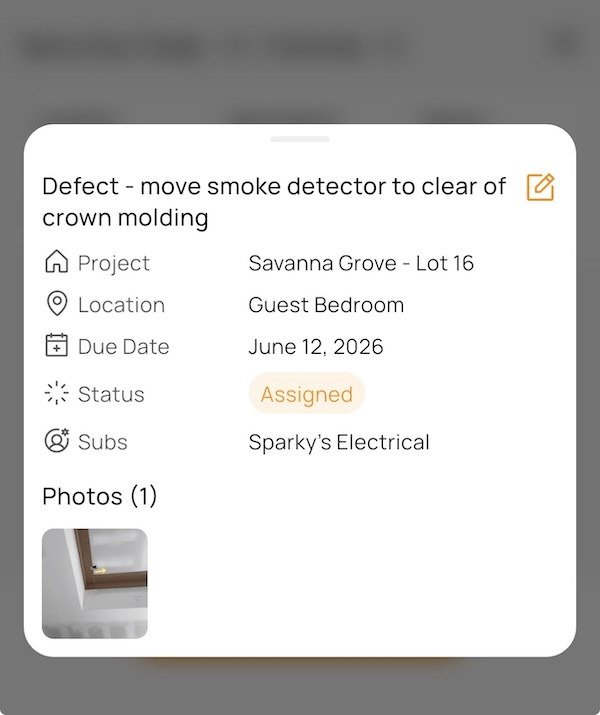
An electrical punch item with photo, exact location, due date, assigned electrician, and status. Everything he needs to fix it without calling you back.
Electrical items need to be specific about behavior, not just location, because the problem is functional and the wall doesn't talk. A good electrical punch item uses six things, every one of them a field PunchPad already has:
A photo. Snap the outlet, the switch gang, the panel, the fixture box. If a breaker's labeled wrong, photograph the panel directory. The photo kills the "which one did you mean" trip back.
Exact location. "Bedroom" is not a location. Use the Location field for the room, and get specific in the title: "north wall, right outlet of the two-gang by the closet." He's walking the house with a meter and a bag of plates. He needs to find it without you there.
The specific behavior in the title, not just "broken." "Dead, no power" is different from "GFCI won't reset" is different from "switch works but controls the wrong light." Write what it does now and what it should do. "Three-way at top of stairs should kill the hall sconce. Does nothing." That's an item he can diagnose before he leaves the shop.
The category as the first word of the title. PunchPad doesn't sort items by type, so you do it with the title. Start code items with CODE, defects with Defect, and waiting-on-material items with Waiting. Now the first word of every item tells him whether it blocks your CO, whether it's his to fix on his dime, or whether it's on you to get him the fixture.
A due date tied to something real. "Before the final on the 18th." Not "soon." Electrical due dates should hang off the inspection or the closing, because those are the dates he respects. Code items get the earliest dates so they rise to the top when you filter by due date.
The sub it’s assigned to. Every item gets tagged to the electrical sub, so you can filter the whole list down to just their work and hand them a clean link.
When every item has these six, two things happen. He can't claim he didn't understand the request. And when he marks it done, you've got a before photo and a date stamp, so "I fixed that last week" doesn't fly when the outlet's still dead.
Sort the list into three buckets before you send it
This is the move that ends most of the standoffs. The app won't sort it for you, so you make the call and carry it two ways: the item title and the due date.
Walk the job and put every electrical item into one of three buckets:
Code. Anything on the AHJ's notice. Missing AFCI or GFCI protection, improper grounding, smoke and CO not interconnected, a panel the inspector flagged as unlabeled. Non-negotiable, blocks your CO, his to fix on his dime. Title starts with CODE. Due date is the inspection date.
Defect. Dead outlets, miswired three-ways, crooked devices, missing cover plates, a dimmer buzzing because it's the wrong type for the load. Warranty work, already in his price. Title starts with Defect. Due date is 7 to 10 days.
Waiting. Fixtures not delivered, the cracked chandelier, the backordered vanity lights. Not a defect, not his fault. Title starts with Waiting. No due date until the fixture's on site, then you set one.
Why bother: when your electrician opens the live link, the first word of every item tells him what he's looking at, and the due dates tell him what to do first. He can see he actually owes you eight things this week, not twenty, and that the CODE items come due on the 18th. That's a list he acts on instead of one he ignores.
The buckets are also a money conversation, not just a labeling one. The retainer covers Code and Defect, the work he owes you. Waiting items get billed separately if he agrees to install owner-supplied fixtures. Keep them straight and be honest with him about which bucket each item is in. Electricians know the difference between their wiring and a bad fixture, and the ones who keep coming back to your jobs are the ones who don't feel blamed for the homeowner's pendant light.
Assign every item to the sub
PunchPad tags every punch item to a sub. Use it on all of them. No floating items, no "who was supposed to handle this." If it's electrical, it's assigned to your electrical sub.
The payoff is the live link and the filter. Filter the list by your electrician and you've got a clean view of only their open items, nothing from the plumber or the framer in the way. Share that link and they see exactly what's theirs, with their company on it, no app and no login. The whole job's punch list could have sixty items on it, but the electrician opens his link and sees the eight that are his.
An item with no sub assigned is an item nobody owns. It sits there until closeout and then it's a surprise. When more than one trade is still on the job, the sub tag is also what keeps them from arguing about whose item is whose. The electrician can't claim the dead outlet is the low-voltage guy's problem when the item's tagged to him and sitting on his link.


Time your punch walk for electrical: you get two shots, not one
Electrical is different from paint here, and it's the most important thing in this post. Paint gets one punch walk. Electrical gets two, and if you skip the first one you pay for it with a wall.
Walk the rough-in before drywall. Box heights, can locations, outlet and switch placement, the panel, every wire run before it's buried. This is your only chance to catch a mislocated box or a missing home run while fixing it costs ten minutes instead of a drywall patch and a repaint. A switch that ends up behind a door, an island missing its outlet, a can light centered on the wrong joist. All cheap now, all expensive after the rock goes up.
Sign off on the rough-in. Get the inspection passed and photograph the open walls. Now you have a record of what was right before it got covered.
Walk trim and final separately. Devices, plates, fixtures, panel labeling, GFCI and AFCI testing, smoke and CO interconnect, exterior fixtures. This is the punch list this whole post is about.
The builders with ten-item electrical punch lists are the ones who walked the rough-in hard. The builders with fifty-item lists found out at trim that a box is in the wrong place and now they're opening a finished wall. We wrote more on why mid-phase punch walks save you weeks at closeout, and for electrical it's not optional. The rough-in walk is a pre-drywall punch list.
The payment lever, tied to the permit
Retainage works on electricians, but the real lever is the permit and the final inspection. Use both.
Standard play: 5% to 10% held back, in the contract on day one. For electrical, tie the release to two things, not one. Final payment and retainage release when your punch list is closed and the electrical final passes and the permit closes. He needs that permit closed as much as you do. It's his license on the open permit. Make the closeout and the release the same event and he's chasing you for the check instead of you chasing him for the work.
Here's the part nobody likes to say out loud: because you can't easily bring in another electrician and back-charge him the way you would a painter, retainage matters more on electrical, not less. The retainer is most of your leverage. Don't give it up early. Don't release on "it's basically done." Release when the final passes.
For electricians you already work with, introduce it on the next house. "Going forward I'm holding 5% until electrical final passes and punch closes. Here's why." The ones who push back hard are telling you they expect to leave items open. Useful information.
What to do when the electrician keeps ducking
When you've done everything right and he's still not showing, here's the escalation, with the honest caveat that your alternatives are worse than they are with any other trade.
First conversation: in person or on the phone, not text. Show him the open CODE items and the inspection date. Ask when he's coming. Get a date. Write it down.
Date slips, second conversation: "Dave, you said Thursday. It's Monday. Final's on the 18th and these three items block the CO. New plan." Get a new date. Tell him this is the last reschedule.
Date slips again: this is where electrical is different. Before you bring in another electrician, understand the cost. A new guy may refuse to take over the open permit, may want to re-inspect the whole job, and will almost certainly charge a premium to put his license on someone else's panel. Sometimes that's still the right call. Often the better move is to escalate the money and the relationship: the retainer doesn't release until final passes, and his spot on your next three jobs depends on how this one closes.
Whatever you decide, every item in your list carries its photos, due dates, and status changes. If you bring in another electrician and back-charge, or if he disputes the retainer, that record settles it in five minutes. Most standoffs exist because the builder can't prove the timeline. Take that away from him and the standoff disappears.
Track who's actually finishing without becoming the bad guy
You shouldn't be texting your electrician every Monday to find out whether the GFCI got reset. You should open your punch list and see it. What's still open. Who it's assigned to. When it was marked done. The before photo next to it.
Spreadsheets can't do this. Group texts can't do this. The inspector's notice stapled to a PDF can't do this. They put you in the position of being the guy who has to remember every item and chase every sub.
What you want is one list that's always current, that you can filter by sub or location or status, that updates the second an item closes, and that your electrician can open without an app or a login. He clicks a link in his browser, sees the open items, fixes them, you mark them done, the link updates. No "did you get my text." No two versions of the inspection notice.
If you're tired of the texts and the PDFs, PunchPad gives you one live link your subs can open in any browser. No app for them to install. No login. They see what's open. You see who's actually moving.
FAQ
Who pays for electrical punch fixes, the builder or the electrician?
Depends on the bucket. Install defects, dead outlets, miswired switches, crooked devices, missing plates, are the electrician's responsibility under his original price. Code corrections from the inspector are also his. But items waiting on owner-supplied or backordered fixtures aren't a defect and aren't his fault. Keep those clearly noted, start the title with Waiting, and don't hold them against him. Mixing the three is the fastest way to make a good electrician stop returning your calls.
Why won't my electrician come back to finish the punch list?
Three reasons, usually together. Good electricians are booked solid, so your small trim list loses to bigger billable jobs. He can't send an unlicensed helper to finish it the way other trades can, so it waits for a licensed guy. And inspection re-trips cost him time, so he batches everything into one trip. Tightening the list, assigning every item to the sub, and putting your code items first all help move you up his schedule.
Can I hire a different electrician to finish the punch list?
You can, but it's harder than with any other trade. The original permit is usually in the first electrician's name, and a new electrician may refuse to take it over without re-inspecting the whole job, and will likely charge a premium to put his license on someone else's work. Treat it as a last resort. Your stronger lever is retainage tied to the final inspection and a documented record for the back-charge.
Can I withhold the electrician's final payment until the punch list is done?
Yes, if it's in the contract. Standard retainage is 5% to 10%, and for electrical you should tie the release to passing the final inspection and closing the permit, not just to your own eyeball. Withholding payment you didn't structure up front is a legal gray area and damages the relationship. Add it to your subcontracts going forward.
What's the difference between an inspection correction and a punch list item?
An inspection correction is issued by the authority having jurisdiction and blocks your certificate of occupancy until it's fixed and re-inspected. A punch item is anything you or the buyer want corrected before closeout. Code corrections are the non-negotiable subset of your punch list. Put both on one list so nothing falls through, and lead the title of every code item with the word CODE so your electrician knows which ones gate the CO.
My electrician says it's the dimmer or the bulb, not his wiring. Is that true?
Sometimes. LED and dimmer compatibility is a real problem, and a non-dimmable bulb on a dimmer will buzz or flicker no matter how good the wiring is. But "it's the fixture" is also the easiest way to deflect blame. Make him prove it by swapping in a known-good dimmer or bulb. If the problem follows the device, it's the device. If it stays, it's the install.
How long should an electrician have to finish punch list items?
Reasonable default is 7 to 10 days for in-stock trim work like plates, devices, and resets. Longer when an item is waiting on an owner-supplied or backordered fixture, which isn't on him. Set the date when you assign the item, tied to the inspection or closing date, and get any change to it in writing.
Should I do an electrical walk before drywall?
Yes, and it's the single biggest thing you can do to keep your final punch list short. Walking the rough-in before drywall lets you catch box locations, can placement, and missing runs while fixing them costs minutes instead of a wall patch. It also creates a dated record of the wiring before it's buried, so anything that comes up later is clearly traceable. The rough-in walk is your cheapest punch walk by a mile.
